Buying Your First Car: 12 Checks Before You Commit
Your first car has to do more than look good on the drive. It needs to fit the total monthly budget, suit the journeys you actually make and survive the basic history, document and condition checks. Work through those questions before discussing a deposit or signing a finance agreement.
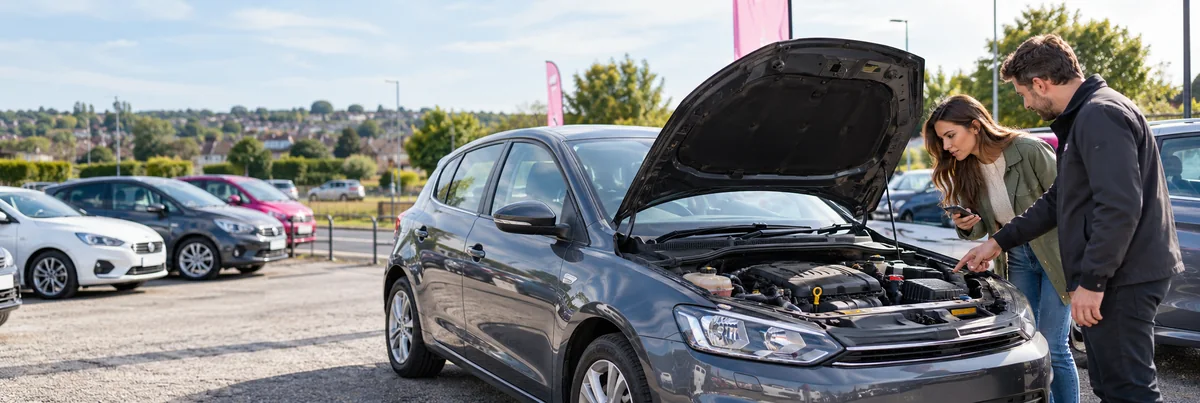
Buying a first car is exciting, but it is also one of the first large financial decisions many drivers make. A hurried choice can leave you with an insurance premium larger than expected, an unsuitable finance agreement or repairs that the original budget never allowed for.
This guide focuses on the practical UK checks that help you slow the decision down without taking the enjoyment out of it.
1. Set a total monthly car budget
Start with what the car can cost you each month—not merely the finance payment.
Allow for:
- finance or savings used to buy the car;
- insurance;
- vehicle tax;
- fuel or charging;
- servicing and MOT costs;
- tyres, consumables and repairs;
- breakdown cover;
- parking, permits and clean-air charges; and
- a reserve for unexpected faults.
Some of these bills arrive annually. Divide them by 12 so the monthly budget reflects reality. Leave breathing room rather than spending up to the last available pound.
2. Get an insurance quotation before choosing the car
For a new driver, insurance can materially change which car is affordable. Two similarly priced hatchbacks can produce very different premiums because insurers assess the vehicle, driver, address, occupation, expected mileage and other risk factors.
Use truthful details and quote on the exact registration where possible. Do this before paying a holding deposit. Never list somebody else as the main driver when the first-time buyer will actually use the car most; that can amount to insurance fraud, commonly known as fronting.
Also check the compulsory and voluntary excess. A cheaper premium with an unaffordable excess may not be good value.
3. Match the car to real journeys
Think about an ordinary week:
- Is most driving in town, on motorways or on rural roads?
- How many people and how much luggage will normally travel?
- Is there somewhere suitable to park or charge it?
- Will clean-air-zone rules affect regular destinations?
- Does the driver need an automatic licence-compatible car?
- Is the annual mileage realistic?
A large engine, expensive trim or very low-profile tyres may look appealing but increase insurance, fuel and replacement costs. Equally, buying the smallest possible car is not helpful if it cannot perform the journeys safely and comfortably.
4. Check the vehicle with GOV.UK before viewing
Ask the seller for the registration number, make and model. GOV.UK recommends checking that the supplied details match DVLA records, reviewing MOT status and history, and checking for safety recalls.
Read the MOT history rather than only checking whether a current certificate exists. Look for:
- mileage progression;
- repeated advisories;
- corrosion;
- worn tyres or brakes;
- suspension defects; and
- periods when the car appears not to have been tested.
An advisory is not automatically a reason to reject a car, but recurring items help you ask better questions and anticipate costs.
5. Verify the V5C, VIN and seller
At the viewing, inspect the original V5C registration certificate—the log book. Check that the registration, make, model and vehicle details agree with the car.
Locate the vehicle identification number and make sure it matches the V5C. Be cautious if numbers appear tampered with, the seller will not show the documents, or the meeting location and keeper information do not make sense.
Remember that a V5C records the registered keeper; it is not, by itself, proof of legal ownership.
For a private sale, establish that the seller is entitled to sell the vehicle. For a dealer or finance broker, check the business identity and, where financial services are involved, use the FCA Firm Checker rather than trusting a logo or register number copied onto a website.
6. Check for outstanding finance and write-off history
The free government checks do not provide every piece of commercial history. Consider a reputable vehicle-history check for information such as outstanding finance, theft records and insurance write-off markers.
If finance remains secured against a car, the seller may not have the right to sell it without settling that agreement. Do not rely on a verbal promise that it will be dealt with later.
Understand any insurance category shown in the history and consider an independent inspection. A repaired car is not automatically unsuitable, but the repair quality, safety, insurance implications and future value matter.
7. Inspect it in daylight and test drive it properly
Do not inspect a wet car in darkness if you can avoid it; both conditions can hide bodywork defects.
Check:
- all tyres, including tread and uneven wear;
- fluid levels and visible leaks;
- warning lights at start-up;
- lights, wipers, heating and air conditioning;
- windows, locks and infotainment;
- body-panel alignment and paint differences;
- service records and invoices;
- both keys; and
- signs of damp or water ingress.
On a test drive, listen from cold if possible. Use a mixture of roads and check clutch operation, gear changes, braking, steering, suspension noise and whether the engine reaches and maintains a normal temperature.
If you do not know what you are looking for, take an experienced person or pay for an independent mechanical inspection. The fee can be small compared with an avoidable engine, gearbox or structural problem.
Make sure you are legally insured to drive the vehicle during the test.
8. Ask what the warranty really covers
“Comes with a warranty” is not enough information. Ask for the terms before buying:
- duration;
- claim limit;
- covered and excluded components;
- labour-rate restrictions;
- servicing requirements;
- excesses; and
- where repairs can be performed.
A warranty sits alongside applicable statutory rights; it does not erase them. Rights differ between a dealer purchase and a private sale, so understand who is actually selling the car.
Citizens Advice explains that a faulty used car bought from a dealer may give the consumer rights to a repair, the cost of repair, or some or all of the money back depending on the circumstances. A simple change of mind is different from a fault.
9. Compare ways to pay
Cash, a personal loan, Hire Purchase, Personal Contract Purchase and other products work differently. Availability depends on circumstances, and not every option will suit a first-time buyer.
With Hire Purchase, payments are made over an agreed term and ownership normally transfers after the required payments and any purchase fee. With PCP, lower regular payments may be accompanied by a substantial optional final payment if you want to own the car. Personal Contract Hire is a lease and normally offers no ownership option.
Before choosing, compare:
- deposit;
- APR;
- monthly payment;
- number and term of payments;
- total amount payable;
- fees and final payments;
- mileage or condition restrictions where relevant;
- early-settlement or termination provisions; and
- who owns the car during and after the agreement.
Do not choose a product solely because it produces the smallest monthly number.
10. Understand soft and hard credit searches
A soft search can be used for eligibility or quotation purposes and is not visible to other lenders in the same way as a hard application search. A hard search is normally recorded when a full credit application is made.
Ask which type will be performed and at what point. Avoid applying repeatedly simply to see what happens.
CreditCar's initial application uses a soft search, so the eligibility stage does not affect your credit score. A lender may carry out a hard search if you later choose to proceed with a full application.
Having little or no borrowing history can make assessment harder even when nothing negative is recorded. Registering to vote where eligible, checking all three credit reports and maintaining accurate address information can help ensure lenders are assessing the correct person and data.
11. Read before signing
Take time to read the pre-contract information and agreement. Check that the vehicle, cash price, deposit, rate, payments, total payable and any optional products match what was discussed.
Ask questions about anything unclear. Do not allow collection arrangements or excitement about the car to rush the financial decision.
Keep copies of:
- the advert;
- order form and invoice;
- finance documents;
- warranty terms;
- history-check result;
- written promises about work to be completed; and
- messages exchanged with the seller.
Verbal assurances are difficult to prove later.
12. Complete the handover properly
Before driving away:
- arrange valid insurance;
- tax the vehicle—the previous keeper’s tax does not transfer;
- obtain the green new-keeper slip or correct digital confirmation;
- confirm how and when the DVLA keeper change will be made;
- receive all keys, documents and agreed accessories;
- photograph the condition and recorded mileage; and
- record the next MOT, service and insurance dates.
GOV.UK states that a used vehicle must be taxed before it is used on the road. Do not assume the dealer or seller has completed this unless you have confirmation.
Your first car should remain affordable after the excitement
The strongest first-car decision is often an unglamorous one: a sound, insurable vehicle with documented history and a payment that leaves room for maintenance. That creates far more freedom than a car that absorbs the whole monthly budget.
CreditCar is a credit broker, not a lender. If finance is appropriate for your circumstances, we can introduce eligible applicants to lenders from our panel. Acceptance and terms are subject to status and affordability.
Explore our used cars, read more about car finance, or check your eligibility with a soft-search application when you have chosen a sustainable budget.
Useful official guidance
- GOV.UK: Checks when buying a used vehicle
- GOV.UK: Check MOT history
- GOV.UK: Check for a vehicle safety recall
- MoneyHelper: How to buy and finance a car
- MoneyHelper: Cost of running a car
- Citizens Advice: Problems with a used car
- FCA Firm Checker
This guide provides general information, not personal financial or legal advice. Finance is subject to status, affordability and lender criteria.